
Pavel Prokopic – Nested Cinema
Nested Cinema
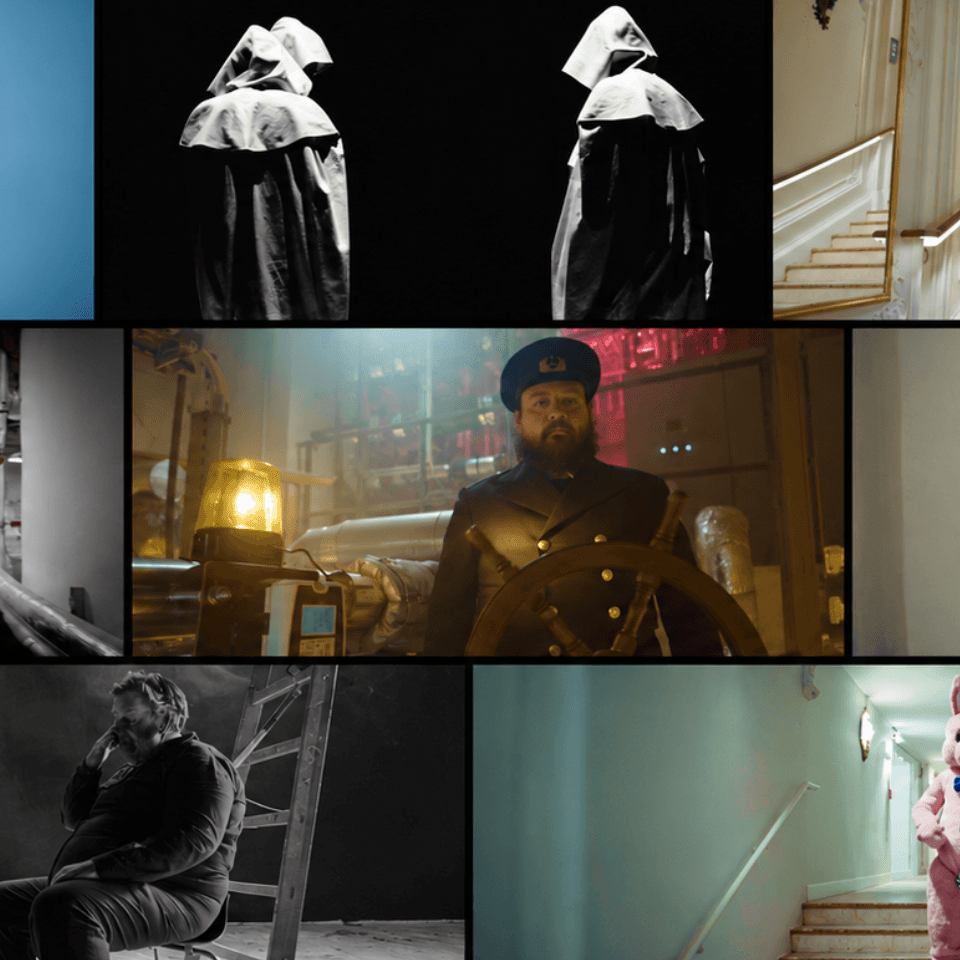
For over a century, cinema has meant one screen. Nested Cinema explores what happens when it doesn’t have to. At BEYOND 2026, the project presents a new walk-through work: a section of Sisyphos, the triptych film by Kay Voges and Andrea Schumacher, expanded into the room through screens, light and spatial sound.
Sisyphos is about the absurdity of existence and the beauty of repetition. Three simultaneous films merge into one audiovisual composition: a theatre porter guards the house, painters pursue their calling, nebulous figures repeat ghostly formations and a submarine captain must send the distress signal. Shown here as an infinite loop, the film has no beginning to wait for and no plot to follow. Visitors can arrive at any point, sit, stand or walk, and stay as long as the loop holds them.
Nested Cinema reimagines film by orchestrating technology in layers around it – screens, the physical space, light, sound and virtual reality – so that atmosphere, not story alone, shapes the experience. After a 2023 pilot at MediaCityUK, the project is now in the first year of an AHRC Catalyst award at the University of Salford, building a portable system that can pop up in cinemas and other venues and give existing films a new life in space.
BEYOND is the installation’s first public showing, and visitors’ responses will shape what comes next: a fuller exhibition planned for MediaCityUK in early 2027, in which audiences move through three spatial renderings of the film, and a call for filmmakers to expand their own work.
About Pavel
Pavel Prokopič is a Czech filmmaker and lecturer at the University of Salford, and the creator and principal investigator of Nested Cinema. His current work focuses on advancing cinema as a unique form of art and storytelling by combining creative experimentation, philosophical concepts and cutting-edge technologies. He is also the co-founder and principal investigator of the International Network of Experimental Fiction Filmmaking (INEFF). His work has been widely published, exhibited and presented, including at FACT and the V&A Museum, and in the Leonardo journal and the Journal for Artistic Research. He holds an AHRC-funded PhD and a Master’s degree in Film Aesthetics from Magdalen College, University of Oxford.
Jayne Sayer – Project Co-lead
Jayne Sayer co-leads the Nested Cinema project and is a lecturer and researcher exploring the intersections of production design, immersive cinema and expanded screen technologies. Her work investigates spatial narrative through reactive lighting, multi-screen installation and 180°/360° cinematography, using design-led practice-as-research methodologies. She examines how emerging technologies reshape storytelling, audience experience and film pedagogy, and collaborates through international research networks including the Production Design Research & Education Network. Her outputs include immersive exhibitions, conference presentations, funded pedagogic research and prototype development. For Nested Cinema, she designed the immersive set and smart lighting system of the 2023 pilot and now leads the project’s dynamic lighting design.
Stuart Haffenden Cornejo – Project Co-lead
Stuart Haffenden Cornejo is heading the technological development that combines screens, sound and dynamic lighting with traditional cinema spaces. The project is a chance to put his research into embodied, human-centred design to work in a new setting: cinema. A multidisciplinary practitioner in web, audio and immersive technologies, he holds an EPSRC joint-funded PhD in Digital Innovation from Lancaster University, where he developed auditory interfaces for runners and a smart wearable prototype, blending sound and interaction design to improve running posture. He is Programme Leader for BSc Creative Computing.
Andy Miah – Project Co-lead
Professor Andy Miah’s work explores the relationship between emerging technologies, human experience and culture. His practice works across digital media, immersive technologies, AI, extended reality and speculative futures, bringing together artistic experimentation with critical research. His work sits at the intersection of art, science and technology, creating spaces for audiences to encounter complex technological ideas through creative and experiential forms. With previous roles at the Royal College of Art and the Foundation for Art and Creative Technology, Professor Miah has worked with artists, designers and technologists to realise new creative propositions that challenge our understanding of what it is to be human.
Sisyphos is directed by Kay Voges and Andrea Schumacher.
Kay Voges – Director, Sisyphos
Born in Düsseldorf, Kay Voges is a theatre director and founding director of the Academy for Theatre and Digitality in Dortmund. For Voges, stages are machines, and human beings always appear in relation to technology. Since 1998 he has directed at theatres and opera houses including the Burgtheater in Vienna, the Berliner Ensemble and the Volksbühne Berlin. He has served as Artistic Director of Schauspiel Dortmund and the Volkstheater in Vienna, receiving numerous awards for his innovative productions at major theatres. Since the 2025/26 season, he has been Artistic Director of Schauspiel Köln, where he continues to explore the relationship between humans, technology and democracy.
Andrea Schumacher – Co-director, Sisyphos
Andrea Schumacher, a filmmaker born in Essen in 1967, draws on decades of experience in film and media. Her career has been shaped by collaborations with renowned filmmakers and artists, including Helge Schneider, Werner Nekes, Christoph Schlingensief, Adolf Winkelmann and Kay Voges. She has developed concepts for films, television documentaries, advertising and theatre, while also working as a screenwriter, director, cinematographer and editor. Since 2019, she has collaborated with Kay Voges on projects including Inferno, an opera film based on Dante Alighieri’s Divine Comedy, and RCE #remotecodeexecution at the Berliner Ensemble. The latter won a 2025 Faust Prize in the Media category. She lives in Berlin with her two sons.